
The Iceberg Model explains that what we see in a person, such as their actions, words, decisions, and results, represents only a small part of their personality, while the real reasons that drive them to act remain hidden beneath the surface. Every behavior a person displays is influenced by a combination of emotions, beliefs, needs, values, and identity, which shape the way they think and make decisions. Therefore, understanding the hidden levels of personality helps us understand ourselves and others more deeply, and it is considered one of the important models used in psychology, personal development, leadership, coaching, and effective communication.
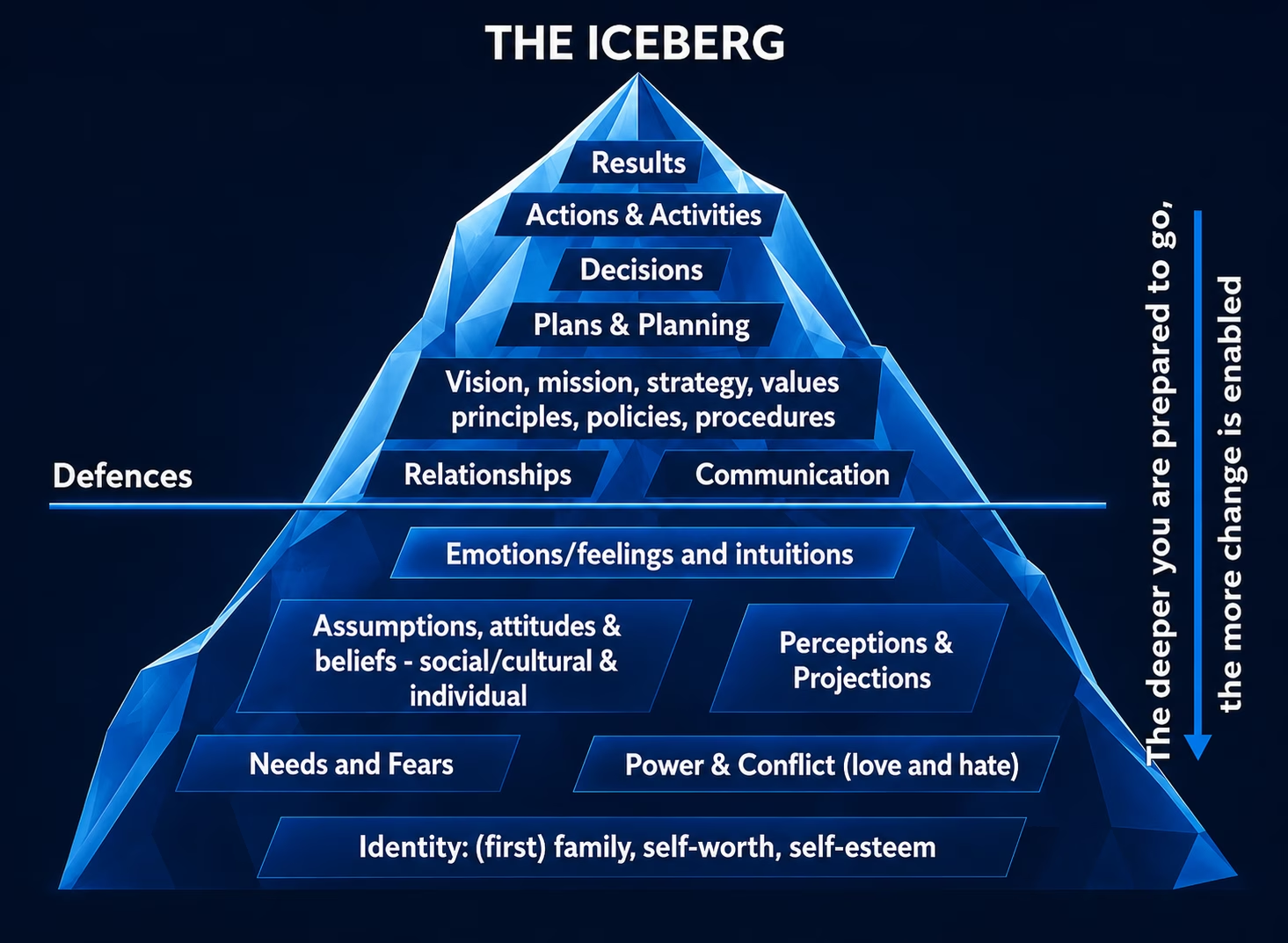
When we face a problem in our personal or professional lives, the first thing we notice is what appears before our eyes: a person behaving in a certain way, a team suffering from low productivity, a company losing customers, or a student receiving low grades. Our first attempts to solve the problem are often directed toward this visible part, so we try to change the behavior directly, improve performance, or address the final outcome. However, after some time, we often discover that the problem has returned or appeared in a different form.
The reason is that most problems do not begin at the surface, but originate in much deeper layers. What we see is only the final outcome of a long chain of psychological, cognitive, emotional, and social processes that came before it. This is where the Iceberg Model helps explain that behavior, decisions, and results represent only the small visible part of the iceberg, while the real causes remain hidden beneath the surface, where identity, beliefs, needs, fears, perceptions, emotions, and internal conflicts exist.
Today, this model is used in many fields, such as psychology, coaching, leadership, business management, systems thinking, and problem analysis, because it helps shift our focus from treating symptoms to addressing root causes, leading to deeper and more sustainable change.
The problem is often not what you see, but what you do not see.
The Iceberg Model is an analytical framework that explains that visible events are only the result of deeper layers that continuously influence them. The model resembles a real iceberg, where only a small portion appears above the surface of the water, while approximately 90% of its volume remains hidden beneath it. Although the visible part is the only part that can be easily observed, the hidden part determines the shape, size, and direction of the iceberg.
Similarly, a person, organization, or society possesses internal layers that are not immediately visible, yet they influence everything that appears on the surface. Therefore, sustainably changing results requires going deeper into these layers, understanding them, and working on them rather than merely addressing visible behavior.
What appears above the surface
Results
Actions
Decisions
Communication
What exists beneath the surface
Emotions
Perceptions
Beliefs
Needs
Identity
The importance of the Iceberg Model lies in the way it changes how we look at problems. Instead of focusing on the question, "What happened?", it encourages us to ask deeper questions, such as: "Why did it happen?", "What led to it?", and "What needs to change so that it does not happen again?". In this way, thinking moves from addressing outcomes to addressing the real causes.
The model also helps us understand that people do not behave randomly. Every behavior they display reflects a complex internal system that includes their beliefs, values, fears, past experiences, and the way they perceive the world.
| Surface-Level Perspective. | Iceberg Model. |
|---|---|
| Focuses on the result. | Focuses on the cause. |
| Treats symptoms. | Addresses root causes. |
| Temporary solutions. | Long-term change. |
| Explains only the behavior. | Explains why the behavior appeared. |
The model is based on a simple but extremely important principle: every result we see today is the end of a long chain of causes that began in much deeper layers. Therefore, meaningful change must begin from within and then gradually be reflected in thinking, emotions, communication, decisions, behavior, and finally results as its effects appear on the surface.
The deeper you go into the iceberg, the closer you get to the real cause of the problem.
After understanding the idea of the model, we will begin studying its layers in detail, starting with the deepest layer, Identity, because it represents the foundation upon which all the other layers are built and directly or indirectly influences every decision, behavior, and result that appears afterward.
The Iceberg Model is based on a simple but highly influential idea, one that is important in psychology, systems thinking, leadership, and coaching: what we see represents only a small part of the truth. Just as only a small portion of an iceberg appears above the surface of the water while most of its volume remains hidden beneath it, human behavior, organizational performance, decision outcomes, and the nature of relationships all conceal deeper layers that cannot be directly observed.
For this reason, people who focus only on visible results often arrive at temporary solutions because they treat symptoms rather than causes. Those who learn to search beneath the surface become better able to understand people, analyze problems, and create sustainable change.
What you see is the result; what you do not see is the cause.
The visible part of the iceberg represents everything that can be directly observed, whether in individuals, teams, organizations, or societies. It includes daily behaviors, words that are spoken, decisions that are made, plans, results, performance levels, successes, and failures.
This part is characterized by being easy to observe, measure, and describe, which is why most people tend to focus on it because it does not require deep analysis. When we see an employee arriving late to work, a student receiving low grades, or a company losing part of its market share, these are all visible events that everyone can observe.
But the problem is that this part tells us only what happened; it does not tell us why it happened.
Beneath the surface of the water are the layers that create everything visible above it. These include identity, needs, fears, beliefs, assumptions, perceptions, emotions, internal conflicts, values, motivations, and past experiences. These elements cannot be directly observed, but they influence every decision, every behavior, every relationship, and every result.
Therefore, two people may behave in the same way while having completely different internal reasons. One person may refuse to participate in a meeting because they fear criticism, while another refuses because they believe the meeting is not useful. The visible behavior is the same, but the internal motivation is different.
The Visible Part
Results
Actions
Decisions
Communication
The Hidden Part
Identity
Needs
Fears
Beliefs
Perceptions
Emotions
Because the hidden part creates the visible part. If identity changes, beliefs change. If beliefs change, the way reality is interpreted changes. If interpretation changes, emotions change. If emotions change, communication changes. Then relationships change, followed by decisions, behavior, and finally results.
Therefore, any change that begins only from the outside is fragile because it has not changed the forces that produced the problem in the first place.
| The Visible Part. | The Hidden Part. |
|---|---|
| Easy to see. | Difficult to observe directly. |
| Represents results. | Represents causes. |
| Often addressed through orders or instructions. | Requires understanding, analysis, and awareness. |
| Changes quickly. | Changes slowly but is more sustainable. |
When a manager addresses low productivity simply by increasing working hours, results may improve temporarily. However, if the real cause is low motivation, lack of trust, or poor leadership, the problem will return.
Similarly, when a person tries to eliminate a bad habit simply by resisting the behavior without understanding the psychological need that the habit fulfills, they will often return to it after some time because the internal cause remains unchanged.
Treating behavior without understanding its causes is like removing the leaves of a tree while leaving its roots untouched.
After understanding the difference between the visible and hidden parts, we will begin studying the first and deepest layer of the Iceberg Model: Identity. This layer represents the foundation upon which all the other layers are built because it determines how a person sees themselves and the world around them and indirectly influences their decisions, behaviors, and results.
Identity is the deepest layer of the Iceberg Model and one of the most influential factors shaping a person's life. It represents the answer to the fundamental question: Who am I? It is not merely a name, profession, or collection of external characteristics, but an internal system that determines how a person sees themselves, how they interpret the world around them, how they make decisions, and how they behave in different situations.
Before any external behavior appears, there is an internal image of the self. People often do not act based only on reality, but based on the image they hold of themselves in their minds. If someone sees themselves as capable, willing to learn, and capable of growth, they will tend to make different decisions from someone who sees themselves as weak, incapable, or undeserving of success.
This is why identity is considered a starting point for meaningful change. It is difficult to permanently change results if the internal image of the self remains unchanged because people often return to behaviors that are consistent with their current identity.
A person does not act only according to what they want, but according to who they believe they are.
Identity is the collection of ideas, beliefs, experiences, values, and perceptions that form a person's answer to the question: "Who am I?" It is the framework a person uses to understand themselves, determine their place in the world, and choose the way they want to live.
Identity includes several interconnected elements, such as:
One common mistake is confusing identity with behavior. Saying, "I failed at this," is completely different from saying, "I am a failure." The first describes a specific event, while the second turns the event into part of the person's definition of themselves.
When a person connects their identity to a single outcome, they become more vulnerable to fear, stress, and avoidance of new experiences. However, when they see themselves as a person capable of learning, failure becomes information that helps them grow rather than a threat to their identity.
| Fixed Identity. | Growth-Oriented Identity. |
|---|---|
| I cannot. | I have not learned yet. |
| Failure is proof of my weakness. | Failure is an opportunity to learn. |
| I avoid challenges. | I seek opportunities for growth. |
| I protect my image of myself. | I develop my image of myself. |
The process of identity formation begins in childhood. The messages a person receives from their family, environment, and society contribute to shaping how they see themselves. A child who repeatedly hears that they are capable, loved, and important will often develop a positive internal image of themselves.
In contrast, a child who is repeatedly exposed to criticism, comparison, or being made to feel incapable may develop negative beliefs about themselves, even when those beliefs are not accurate.
Over time, these early messages become internal thoughts that influence choices, relationships, and the way a person responds to challenges.
Many of the limitations a person experiences today began as ideas they received about themselves in the past.
Daily decisions are strongly connected to identity. People do not choose only according to benefits, but also according to what is consistent with their image of themselves.
For example, a person who sees themselves as an "athlete" will naturally tend to exercise because the behavior is consistent with their identity. Someone who sees exercise as something temporary that does not represent who they are may find it more difficult to maintain, even if they know its benefits.
Many people try to change their lives by modifying behavior alone, such as trying to read more, exercise, or work harder. But if the identity behind these behaviors does not change, the change is often temporary.
Deeper change begins when a person asks:
After understanding identity as the deep foundation that shapes how a person sees themselves, we will move to the next layer of the Iceberg Model: Power & Conflict. This layer explains the emotional and psychological forces that drive people to act, pursue certain goals, and enter into internal or external conflicts.
Immediately after identity comes the layer of power and conflict, one of the most influential layers in the Iceberg Model. Here, power does not refer only to political or military power, but to all the internal and external forces that push a person toward action or prevent them from acting. It also refers to conflicts that arise when desires, needs, values, or interests come into opposition.
Many behaviors that appear irrational on the surface become understandable when we examine this layer. A person may behave aggressively not because they enjoy conflict, but because they feel threatened. Another person may become excessively controlling because they fear losing security. Someone else may refuse to cooperate because they fear losing their status or influence.
Behind most behaviors there is a force that drives, a fear that prevents, or an unresolved internal conflict.
Power is the ability to influence oneself, others, or the surrounding environment. It does not always mean control; it may also take the form of persuasion, leadership, decision-making, taking responsibility, or regulating emotions.
Power can be internal or external:
The greater a person's internal power, the less they depend on external sources of power to prove their worth.
Conflict is a state of opposition between two desires, goals, values, or interests. It may be internal, occurring within the person, or external, occurring between two people or groups.
Conflict itself is not always negative because it can be a starting point for growth and development when managed properly. However, when it is ignored or handled poorly, it can become a source of stress, struggle, and deteriorating relationships.
| Type. | Description. |
|---|---|
| Internal conflict. | A struggle between two desires or values within the same person. |
| Interpersonal conflict. | A difference in goals, interests, or expectations. |
| Organizational conflict. | Conflict within a team or organization because of roles or resources. |
| Social conflict. | Cultural, political, or economic differences. |
People seek power for several psychological reasons, including the need for security, the need for independence, the desire to influence, the pursuit of achievement, and self-protection. When these needs are fulfilled in healthy ways, power becomes a means of building, leading, and serving others.
However, when a person feels threatened or inadequate, they may use power defensively, such as through control, manipulation, aggression, or belittling others, in an attempt to compensate for an internal sense of insecurity.
True power does not need to constantly prove itself, while fragile power is always searching for someone to influence.
Identity directly influences the way power is used. A person with a stable identity does not feel the need to impose themselves through force because they derive their sense of worth from within. In contrast, a person whose sense of worth depends on the opinions of others may try to prove themselves through control, excessive competition, or a constant search for recognition.
Therefore, many conflicts are not actually caused by the problem itself, but by the way each party sees themselves, their status, and their rights.
These conflicts may continue for years if a person does not recognize them because they operate in the hidden part of the iceberg, while their effects appear as hesitation, anxiety, procrastination, impulsiveness, or difficulty making decisions.
After understanding the forces and conflicts that drive people, we reach a deeper layer: Needs & Fears. In this layer, we will discover that many conflicts, decisions, and behaviors are attempts to satisfy basic needs or escape deep fears that influence people even when they are not consciously aware of them.
After identity, power, and conflicts, we reach one of the most important layers of the Iceberg Model: needs and fears. This layer represents the deep psychological forces that drive people to make decisions, build relationships, determine priorities, and interpret the world around them. In many cases, people do not act based on logic alone, but because of a need they want to satisfy or a fear they want to avoid.
A person may believe they chose a particular job because it provides a high income, while the real motivation may be their need for security. They may think they reject a particular relationship because it is unsuitable, while the real reason may be a fear of rejection or losing their freedom. Therefore, understanding needs and fears helps explain many behaviors that appear contradictory or irrational when viewed from the outside.
Behind almost every decision is a need a person seeks to satisfy or a fear they are trying to avoid.
Needs are psychological, physical, and social requirements that people need in order to experience stability, satisfaction, and growth. They are not merely temporary desires, but fundamental motivations that influence thinking, behavior, and decision-making.
Needs differ from one person to another in terms of priority, but many share a set of fundamental areas.
Fears are mental expectations concerning the possibility of harm, loss, or psychological or physical pain. Some fears may be realistic, while others may result from past experiences, beliefs, or inaccurate perceptions.
The problem is not the existence of fear, but the way a person manages it. Fear can encourage caution and planning, but it can also become an obstacle that prevents learning, change, and decision-making.
| Common Fears. | Potential Effect. |
|---|---|
| Fear of failure. | Avoiding attempts or procrastinating. |
| Fear of rejection. | Pleasing others at the expense of oneself. |
| Fear of the unknown. | Resistance to change. |
| Fear of losing control. | The desire to control everything. |
| Fear of loss. | Hesitation in making decisions. |
Every need is often connected to a particular fear. The more important a need is to a person, the more frightening it becomes to lose it. Someone who strongly needs acceptance may fear rejection, someone who needs security may fear change, and someone who needs achievement may fear failure.
Therefore, the same behavior may be an attempt to satisfy a need while simultaneously being an attempt to escape a fear.
People do not move only toward what they want; they also move away from what they fear.
When people make decisions, their minds do not analyze only benefits and costs. They also compare the needs that may be fulfilled with the risks they may face. This is why someone may reject an excellent job opportunity because they fear moving to a new city, or someone may remain in an unhealthy relationship because they fear being alone.
Some people prefer stability over growth, while others prefer adventure over security because their needs are prioritized differently.
The problem is not the existence of fears, but when they become the true leaders of a person's life. When someone avoids every situation that could lead to failure, they stop learning. When they constantly fear criticism, they stop expressing their ideas. When they fear losing control, they exhaust themselves trying to control every detail.
Over time, these fears can turn into beliefs, then habits, and eventually become part of one's identity if they are not addressed consciously.
After understanding needs and fears, we move to the next layer of the Iceberg Model: Assumptions, Attitudes & Beliefs. In this layer, we will discover how past experiences become internal convictions that influence the way people interpret the world and affect all their decisions and behaviors.
After understanding identity, power, conflicts, needs, and fears, we reach a layer that has a major influence on how reality is interpreted: assumptions, attitudes, and beliefs. At this layer, the mind begins constructing internal models of the world, other people, and the self, and then uses these models to interpret everything it sees, hears, and experiences.
People do not interact with reality directly; they interact with their interpretation of reality. This interpretation is influenced by what they believe, what they assume, and the attitudes they have developed over years of upbringing, culture, and personal experiences. This is why two people may experience the same event yet reach completely different conclusions because each person views the event through different lenses.
We do not see the world as it is, but as our beliefs allow us to see it.
Assumptions are conclusions the mind adopts without fully verifying their accuracy. They are mental shortcuts that help people make decisions quickly, but they can also lead to significant errors when they are inaccurate.
For example, a person may assume that a colleague is angry with them because the colleague did not respond to their message, while the actual reason may be that their phone was turned off or that they were busy in a meeting. The problem here is not the event itself, but the assumption used to interpret the event.
Beliefs are ideas that a person considers to be true, whether or not they are actually true. They represent the rules the mind uses to understand the world, make decisions, and evaluate situations.
Some beliefs are supportive, such as:
There are also limiting beliefs, such as:
Attitudes are psychological predispositions that make a person inclined to respond in a particular way toward a person, idea, or situation. They develop as a result of beliefs, past experiences, culture, and environment.
One person may have a positive attitude toward learning, while another may have a negative attitude toward it because of a past educational experience, even though their current reality is completely different.
| Element. | Function. |
|---|---|
| Assumption. | A quick interpretation before sufficient evidence is available. |
| Belief. | An idea a person considers to be true. |
| Attitude. | A psychological tendency to respond in a particular way. |
People are not born with their beliefs; they gradually acquire them from multiple sources, such as family, school, culture, religion, media, society, and personal experiences. Through repeated experiences or messages, some ideas become deeply rooted convictions that are difficult to notice because they become part of a person's natural way of thinking.
This is why many people do not ask themselves, "Is this belief true?" Instead, they treat it as an absolute fact.
Not every idea we believe is a fact; some may simply be old interpretations that we have not questioned for years.
Beliefs influence almost every step of the thinking process. They determine what a person notices, how they interpret it, what they feel about it, and ultimately influence the decision they make and the behavior they display.
If a person believes that failure means they are incompetent, they will avoid new experiences. If they believe that failure is a natural part of learning, they will continue trying despite difficulties.
One of the most important critical-thinking skills is to pause before making a decision and ask:
These questions help reduce errors caused by inaccurate assumptions and beliefs.
After assumptions, beliefs, and attitudes are formed, the mind begins using them to interpret reality. This leads us to the next layer of the Iceberg Model: Perceptions & Projections, where we will see how people create their own psychological version of reality and how they may unconsciously attribute their feelings, expectations, and beliefs to others.
After assumptions, beliefs, and attitudes are formed, the mind begins using them to interpret everything that happens around us. Here we reach the layer of perceptions and projections, which explains that people do not see reality directly. Instead, they see a mental version of reality constructed by the mind based on past experiences, beliefs, and psychological states.
This is why two people can witness the same event and reach completely different conclusions. The external reality may be the same, but each person's internal perception differs according to their experiences, expectations, values, and beliefs.
People do not respond only to what happens, but to the way they interpret what happens.
Perception is the process through which the mind receives information from the senses, then selects, organizes, and interprets some of it in order to construct an image of reality. This image is not an exact copy of reality, but a personal interpretation based on what a person carries within their mind.
Therefore, perception is influenced by many factors, such as:
Because the mind does not receive all the information present in the environment. Instead, it selects a small portion of it and interprets it according to past experiences. Therefore, a person looking for threats may notice danger signals quickly, while someone looking for opportunities may focus on the positive aspects of the same situation.
This does not mean that one of them is lying; it means that each person is looking through a different lens.
| Event. | First Perception. | Second Perception. |
|---|---|---|
| The manager did not smile. | He is angry with me. | He may be busy thinking. |
| No response to the message. | I am being ignored. | The person may be busy. |
| I received criticism. | I am a failure. | This is an opportunity to improve my work. |
Projection is a psychological defense mechanism that occurs when a person attributes their own thoughts, feelings, desires, or fears to others instead of acknowledging that they exist within themselves.
For example, a person may accuse others of not trusting them, while they are actually the one who does not trust others. Or they may believe that everyone is criticizing them, while they are actually the person who criticizes themselves the most.
Sometimes we do not describe others as they are; we describe what is happening inside us without realizing it.
Emotions do not arise directly from events, but from the way a person interprets those events. If a person interprets a situation as a threat, they feel fear. If they interpret it as an opportunity, they feel excitement. If they interpret it as an insult, they feel anger.
Therefore, changing the way an event is interpreted can change the emotional response, even when the event itself remains unchanged.
The mind may repeatedly make errors while interpreting reality, known as cognitive distortions, such as:
All of these distortions influence perceptions, which then influence emotions, decisions, and behaviors.
After the mind interprets reality and constructs its perceptions, an emotional response to the situation emerges. Therefore, in the next layer we will explore Emotions, Feelings & Intuition, where we will understand how emotions influence thinking, memory, and decision-making, and why the mind cannot be separated from emotions when processing information.
After the mind interprets reality through perceptions and projections, the human being begins to experience emotions. Every interpretation constructed by the mind generates a particular emotional response, and this response, in turn, influences thinking, memory, attention, decision-making, and behavior. Therefore, thinking cannot be separated from emotion, because the two constantly work together and influence one another.
For many years, it was believed that human beings made decisions in a purely rational way, with emotions coming afterward. Today, research in neuroscience and cognitive psychology indicates that emotions participate in decision-making from the very beginning. In fact, the absence of emotions may make everyday decision-making more difficult, even when other mental abilities remain intact.
Humans do not think first and then feel; they think, feel, and decide through an interconnected process that occurs at approximately the same time.
An emotion is a rapid psychological and physiological response to a particular situation. When the brain interprets an event as important, the nervous system begins producing a series of physiological changes, such as an increased heart rate, changes in breathing, the release of hormones, or muscle tension. These changes form what we call an emotion.
Emotions are often rapid and automatic, and they do not require conscious thought to begin.
A feeling is the conscious experience of an emotion. An emotion begins within the body, while a feeling is the way a person becomes aware of that emotion, describes it, and interprets it.
For example, your heart rate may increase when you see a dog running toward you. This is the emotional response. Then your mind becomes aware of this change and identifies it as fear, and this is where the feeling emerges.
| Emotion. | Feeling. |
|---|---|
| Automatic response. | Conscious experience of an emotion. |
| Begins in the body. | Experienced consciously by the mind. |
| Rapid. | May last for a longer period. |
Intuition is the mind's ability to reach a rapid conclusion without going through all the steps of conscious reasoning. Intuition often relies on previous experiences and patterns that the brain has learned over time.
When an experienced doctor makes a rapid decision, or a chess player feels that a particular move is better than another, this does not happen randomly. It is the result of thousands of experiences stored by the brain until they become automatic.
Good intuition does not come from nowhere; it comes from extensive experience that has become unconscious.
Emotions influence the way information is processed in several ways. When a person feels fear, attention becomes focused on potential sources of threat, while when a person feels happy, they become more open to creativity and exploring new solutions.
Emotions also influence memory, as people tend to remember events associated with strong emotions more than neutral events.
Therefore, the quality of a decision depends not only on the amount of information available, but also on the emotional state of the person while making the decision.
Emotional intelligence is the ability to recognize, understand, regulate, and use emotions in ways that support sound thinking, healthy relationships, and better decision-making.
A person with high emotional intelligence does not prevent themselves from feeling. Instead, they learn to understand their emotions and manage them without allowing those emotions to control their decisions.
A common mistake is to believe that rational thinking means ignoring emotions. In reality, emotions carry important information about a person's needs, values, and priorities. The problem appears when emotions become the only source of decision-making, or when a person completely ignores them.
True balance means listening to your emotions and then using critical thinking to evaluate them before making a decision.
Emotions are not the enemy of reason, but they need reason to guide them, and reason needs emotions to give it meaning.
After emotions and feelings develop, people begin expressing them to others. Therefore, we move to the next layer in the Iceberg Model: Communication, where we will explore how thoughts, emotions, and intentions move from the inner world to the outer world, and how communication can build trust, create misunderstandings, or lead to conflicts.
After identity, needs, beliefs, perceptions, and emotions are formed within a person, the next stage is expressing them to the outside world, which is the stage of communication. Communication is the means through which a person attempts to convey their thoughts, feelings, intentions, and needs to others, while at the same time trying to understand their thoughts, feelings, and intentions.
Therefore, communication is not simply an exchange of words, but a complex process influenced by all the layers beneath it in the Iceberg Model. What a person says, how they say it, and how the other person interprets it depend on the identity, beliefs, fears, perceptions, and emotional state of each person.
Communication does not transmit words alone; it also transmits the emotions, intentions, values, and expectations behind those words.
Communication is the process of exchanging information, meanings, and emotions between two or more people with the aim of achieving understanding, cooperation, influence, or problem-solving.
Communication consists of several interconnected elements:
Verbal communication includes the words a person uses while speaking or writing. The quality of word choice influences the clarity, accuracy, and likelihood of the message being understood correctly.
Precise, organized, and context-appropriate words reduce misunderstandings, while ambiguous, general, or hostile language increases the likelihood of conflict.
Communication is not limited to words. It also includes facial expressions, body language, tone of voice, speaking speed, physical distance between people, and eye contact. In many situations, people rely on these signals more than on words themselves to understand the intentions of others.
| Type of Communication. | Examples. |
|---|---|
| Verbal. | Speaking and writing. |
| Nonverbal. | Gestures, facial expressions, tone of voice, and body language. |
Many communication problems do not result from the words themselves, but from differences in interpretation. The sender may intend a particular meaning, while the other person receives the message through their own beliefs, perceptions, and emotional state, which may lead to a completely different understanding.
Therefore, effective communication is not limited to delivering a message; it also involves ensuring that the other person understood it as intended.
The success of communication is not measured by what you said, but by what the other person understood.
Listening is not simply remaining silent while another person speaks. It is an active process aimed at understanding the message, emotions, and intentions behind the words. Active listening is one of the most important elements of successful communication because it helps build trust, reduce misunderstandings, and improve the quality of relationships.
Active listening includes:
Emotional state has a significant influence on communication quality. An angry person may hear only what confirms their anger, while an anxious person may interpret neutral messages as threats. Therefore, regulating emotions before entering an important conversation increases the chances of reaching genuine understanding.
When communication between people is repeated, stable patterns of interaction begin to emerge, and this is where Relationships are formed. In the next section, we will explore how trust, cooperation, and influence are built, and how the quality of relationships affects personal and professional success and all the visible outcomes at the top of the iceberg.
After a person communicates with others on a continuous basis, stable patterns of interaction begin to emerge, and these patterns form what we call relationships. A relationship is not simply knowing another person, but rather an integrated system consisting of trust, respect, communication, expectations, shared experiences, and mutual influence.
In the Iceberg Model, relationships do not emerge from nowhere. They are a direct result of what happens in the deeper layers. The way a person communicates depends on their emotions, perceptions, beliefs, needs, and identity. Therefore, the quality of relationships indirectly reflects the quality of what exists beneath the surface of the iceberg.
Healthy relationships are not an event, but a natural result of how we think, communicate, and manage emotions.
A relationship is an ongoing connection between two or more people based on repeated interaction, mutual influence, and the development of a certain level of trust, expectations, and shared responsibilities.
A relationship may be personal, family-based, professional, educational, social, or commercial, but in all cases it is influenced by the way each person treats the other.
Trust is one of the most important factors determining the quality of any relationship. The higher the level of trust, the easier cooperation becomes, the less need there is for monitoring, and the greater the ability to solve problems and face crises.
When trust breaks down, even simple situations can become sources of suspicion, misunderstanding, and conflict.
| Presence of Trust. | Absence of Trust. |
|---|---|
| Cooperation. | Suspicion. |
| Transparency. | Withholding information. |
| Faster problem-solving. | Repeated conflicts. |
| Psychological comfort. | Constant tension. |
Strong relationships do not depend on luck. They are gradually built through a set of repeated behaviors, such as:
A person does not enter a relationship with an empty mind. They carry their beliefs, expectations, and previous experiences with them. If someone believes that people cannot be trusted, they may behave with extreme caution even toward trustworthy people. If someone believes that dialogue can solve problems, they are more willing to listen and seek understanding.
Therefore, many problems that appear to be communication problems actually have their roots in deeper layers, such as fears, beliefs, or identity.
We build our relationships not only through what we say, but also through what we carry within us.
In organizations, the quality of relationships directly influences performance, productivity, creativity, and the ability to solve problems. Teams with strong relationships share knowledge more easily, cooperate more effectively, and handle crises with greater flexibility.
Environments dominated by negative competition and a lack of trust, on the other hand, consume a significant amount of employees' energy in conflicts instead of achievement.
The existence of conflict does not mean that a relationship is unhealthy, because disagreement is natural among human beings. The real difference appears in how the disagreement is managed. Healthy relationships address problems through dialogue, listening, and searching for solutions, while unhealthy relationships turn into exchanges of accusations, defensiveness, and attacks.
Every relationship influences both people. Just as a person influences others, they are also influenced by the way others treat them. Therefore, improving relationships often begins with improving oneself, because a change in one person can lead to a change in the entire dynamic of the relationship.
When relationships become established within a family, organization, or team, they begin to shape the broader culture and the direction in which everyone moves. Therefore, in the next section we move to the layer of Vision, Mission, Strategy, Values, Principles, Policies & Procedures, where we will see how relationships and shared values become a system that guides decisions and behaviors and shapes long-term outcomes.
After relationships are formed and patterns of interaction between individuals become established, the need emerges for a shared framework that guides everyone toward a common direction. This is where vision, mission, strategy, values, principles, policies, and procedures appear. This layer transforms ideas, relationships, and culture into an organized system that helps people make consistent decisions and achieve long-term goals.
Whether we are talking about an individual, family, company, organization, or country, having a clear vision, stable values, and a well-designed strategy makes decisions more consistent and reduces randomness, hesitation, and conflicting priorities.
When a person does not know where they want to go, all paths look alike and every decision becomes confusing.
Vision is the future picture that an individual or organization seeks to achieve. It answers the question:
Where do we want to go?
Vision is not a detailed plan. It is a long-term direction that gives meaning to all efforts and helps align decisions and priorities.
The mission explains the reason an individual or organization exists and the value it provides to others. It answers the question:
Why do we exist?
While vision describes the future, the mission describes the current role that leads toward that future.
Strategy is the overall plan that determines how the vision will be achieved using the available resources. It does not focus on daily details, but rather on major directions, priorities, and resource allocation.
It answers the question:
How will we get there?
| Element. | Question It Answers. |
|---|---|
| Vision. | Where do we want to go? |
| Mission. | Why do we exist? |
| Strategy. | How will we get there? |
Values are the fundamental principles that determine what a person considers important, right, or worthy of respect. They influence all daily decisions, even when a person is not consciously aware of it.
Examples of values include:
Principles are general rules that a person uses to make decisions. If values represent what is important, principles determine how a person behaves in accordance with those values.
For example, if honesty is an important value, the principle may be to tell the truth even when it is difficult.
Policies are general rules that regulate behavior within an organization, team, or family. They aim to standardize how recurring situations are handled.
They help reduce randomness, increase fairness, and clarify expectations for everyone.
Procedures are the practical steps that explain how a particular task should be carried out. They transform policies and strategies into clear daily actions that can be easily implemented.
Vision defines the direction, strategy defines the path, and procedures define the steps.
When vision, mission, and values are clear, decision-making becomes faster and more consistent because a person does not need to rethink every situation from scratch. Instead, they can refer to the framework they previously established.
When this layer is absent, decisions become contradictory and change according to mood, circumstances, or immediate pressures.
After defining the vision, mission, strategy, values, principles, policies, and procedures, the next stage is transforming them into practical steps that can be implemented. Therefore, we move to the layer of Plans & Planning, where we will see how large goals are transformed into programs, priorities, timelines, and actionable steps in everyday life.
After defining the vision, mission, strategy, and values, the next question is: how do we turn these big ideas into reality? This is where planning comes in, representing the bridge between strategic thinking and practical execution. Vision defines the destination, while planning defines the path that leads there step by step.
Many people have beautiful goals and great ambitions, but they do not achieve them because they lack a clear plan. Having a goal alone is not enough. It needs to be broken down into stages, priorities, tasks, and timelines that can be implemented and monitored.
Vision provides direction, while planning turns that direction into organized movement.
Planning is the process of defining goals and then selecting the best methods, resources, and steps needed to achieve them within a specific period of time.
Planning answers several important questions, such as:
| Vision. | Planning. |
|---|---|
| Defines the desired future. | Defines the steps needed to reach it. |
| Long-term. | Short-, medium-, or long-term. |
| Provides direction. | Organizes execution. |
Planning does not occur at only one level. It can be divided into several interconnected levels:
One of the most important functions of planning is setting priorities because time, energy, and resources are limited. Therefore, success does not depend only on doing a large number of activities, but on choosing the activities that have the greatest impact on achieving the goal.
It is not important to do everything; it is important to do the right thing at the right time.
Effective planning does not assume that everything will go as expected. Instead, it takes obstacles, possibilities, and risks into account. Therefore, it usually includes contingency plans that help deal with unexpected circumstances without losing the overall direction.
A plan is not a fixed document. It should be reviewed regularly. Circumstances may change, new information may emerge, or priorities may shift, requiring the plan to be adjusted while maintaining the core vision.
Therefore, successful planning combines clarity with flexibility at the same time.
After preparing the plan, the person begins choosing between different alternatives. Therefore, we move to the layer of Decisions, where we will explore how people choose between available options and how identity, values, emotions, and planning influence the quality of the decisions they make.
After defining their vision, mission, strategy, and then creating a clear plan, a person reaches the stage where all previous layers are transformed into real action: decision-making. A decision is the point of transition between thinking and execution, and it is the moment when a person chooses a particular path from among several possible alternatives.
Many people believe that decisions are based only on logic, but reality is more complex. A decision is influenced by all the layers beneath the Iceberg: identity, needs, fears, beliefs, perceptions, emotions, relationships, values, and plans. Therefore, the visible decision is the final result of a long series of psychological, cognitive, and social processes.
Every decision we make reflects what we believe, what we feel, and what we consider important in our lives.
Decision-making is the process of choosing the best alternative from several available options in order to achieve a particular outcome, solve a problem, or reach a specific goal.
A decision usually begins when a person becomes aware of a gap between the current situation and the situation they want to reach.
Because every person has a different identity, different beliefs, different experiences, and different priorities. One person may choose a stable job because it provides security, while another may choose a business venture because it provides freedom, even though both are facing the same situation.
| Factor. | Influence on the Decision. |
|---|---|
| Values. | Determine what a person considers important. |
| Beliefs. | Determine what a person sees as possible or impossible. |
| Emotions. | Influence the evaluation of risks and opportunities. |
| Experience. | Improves the quality of judgment and prediction. |
| Information. | Increases decision accuracy. |
Not all decisions are the same. They differ according to their nature and impact.
The best decisions are not those that are free of risks, but those based on good information, balanced thinking, and continuous review.
The quality of a decision alone is not enough to achieve success because a decision produces no results unless it is transformed into real execution. Therefore, we move to the next layer: Actions & Activities, where decisions are transformed into habits, behaviors, and daily work that create the results visible at the top of the Iceberg.
After a person makes the appropriate decision, the next stage determines whether that decision will remain merely an idea or become a tangible reality. This is the stage of actions and activities, where all previous layers move from the level of thinking to the level of actual execution.
In the Iceberg Model, actions are among the most visible layers because they represent observable behavior that others can easily notice. However, these actions are not independent. They are the direct result of all the layers beneath them. The way a person works, their habits, level of commitment, and quality of performance all reflect their identity, beliefs, needs, plans, and decisions.
Ideas create decisions, but actions alone create results.
Actions are the practical steps a person takes to achieve a particular goal, while activities are the daily or periodic tasks they perform regularly while implementing their plan.
This layer includes all forms of observable behavior, such as:
| Decision. | Action. |
|---|---|
| Choosing what should be done. | Implementing what was chosen. |
| Mental process. | Behavioral process. |
| May happen within minutes. | May continue for days or years. |
Many people have clear goals, good plans, and sound decisions, but they do not achieve the desired results because they struggle with consistent execution.
Some of the most common reasons include:
Success often does not depend on one major action, but on a collection of small habits repeated day after day. Habits transform behavior from an activity that requires effort and constant thought into an activity that becomes automatic and consumes less energy.
Therefore, building positive habits and eliminating negative habits is one of the most important ways to improve performance over the long term.
What you do every day matters far more than what you do once.
Effective execution requires continuous monitoring because a person may believe they are working hard while the data indicates that they are not making meaningful progress.
Therefore, many individuals and organizations use performance indicators and periodic reviews to answer questions such as:
Many people wait for ideal conditions before starting, while high achievers rely on gradual improvement. They prefer good execution today rather than waiting for perfect execution that may never happen.
Actions represent the final step before results appear. Every habit, activity, and act of execution accumulates over time until its impact becomes visible in the final layer of the Iceberg Model: Results. In the next section, we will see how results are a reflection of everything that happens in the previous layers and why focusing only on results is not enough if we want to achieve sustainable change.
Results represent the tip of the Iceberg, and they are the only part that most people can easily see. When we look at a successful person, a thriving company, a high-performing student, or a professional athlete, we see only the final outcome, while all the processes, factors, decisions, beliefs, and efforts that led to that result remain hidden beneath the surface.
Therefore, the Iceberg Model reminds us that results do not appear out of nowhere. They are the final outcome of a long chain of layers that begins with identity and then passes through needs, beliefs, perceptions, emotions, communication, relationships, values, planning, decisions, and actions.
Results are not the beginning; they are the natural end of everything that happens beneath the surface of the Iceberg.
Results are the final outcomes that can be measured or observed after a series of decisions, activities, and behaviors has been carried out.
Results may be positive or negative, such as:
Because results tell us what happened, but they do not explain why it happened. If a person focuses only on the result, they may attempt to treat the visible symptoms while the real causes remain in the deeper layers.
For example, a manager may notice a decline in their team's productivity, but the real problem may be poor communication, a lack of trust, an unclear vision, or fears within the team, rather than laziness as it may appear on the surface.
| Focusing Only on Results. | Focusing on the Entire System. |
|---|---|
| Treats symptoms. | Addresses causes. |
| Temporary improvement. | Sustainable improvement. |
| The problem keeps recurring. | The likelihood of recurrence decreases. |
Many people connect their personal worth to their results, viewing success as proof of absolute competence or failure as proof of being worthless. But results are not a judgment of a person's value. They are information that helps them determine how effective the system they are operating within is.
If the results are good, this means that most of the layers are functioning appropriately. If the results are poor, they are an invitation to return to the deeper layers and search for the real cause.
Do not ask only: Why did I fail? Also ask: Which layer of the system needs to be improved?
The journey of the Iceberg Model does not end with results. Instead, results begin a new cycle of learning and development. Results provide feedback that helps a person review their identity, beliefs, plans, and decisions, and continuously improve them.
In this way, growth becomes an ongoing process rather than a goal that ends once a particular result has been achieved.
The Iceberg Model teaches us that results are the smallest part of the story and that the real focus should be on the system that produces those results. Sustainable change begins with the deeper layers, not the surface. When identity, beliefs, emotions, communication, relationships, values, planning, decisions, and actions improve, results naturally improve as well.
If you want different results, do not start by changing the results; start by changing the roots that created them.
True development begins when you stop adapting to other people's expectations and start setting your own rules. Through our training packages, we focus on liberating you from limiting patterns, boosting confidence in your decisions, and building a confident personal presence that positively impacts all areas of your life. Invest in your awareness, and turn your potential into tangible results.
Start Your Journey of Change Now© 2022 Copyright All rights reserved. Designed by Tarik Elouahbi.