
Not all tasks deserve the same amount of time and effort. Some produce significant results with minimal effort, while others consume a great deal of energy without providing any real benefit. The Effort–Impact Matrix helps you evaluate tasks and projects based on two key factors: the amount of effort required and the level of impact expected. Through this classification, you can make smarter decisions and invest your time in activities that create the greatest value.
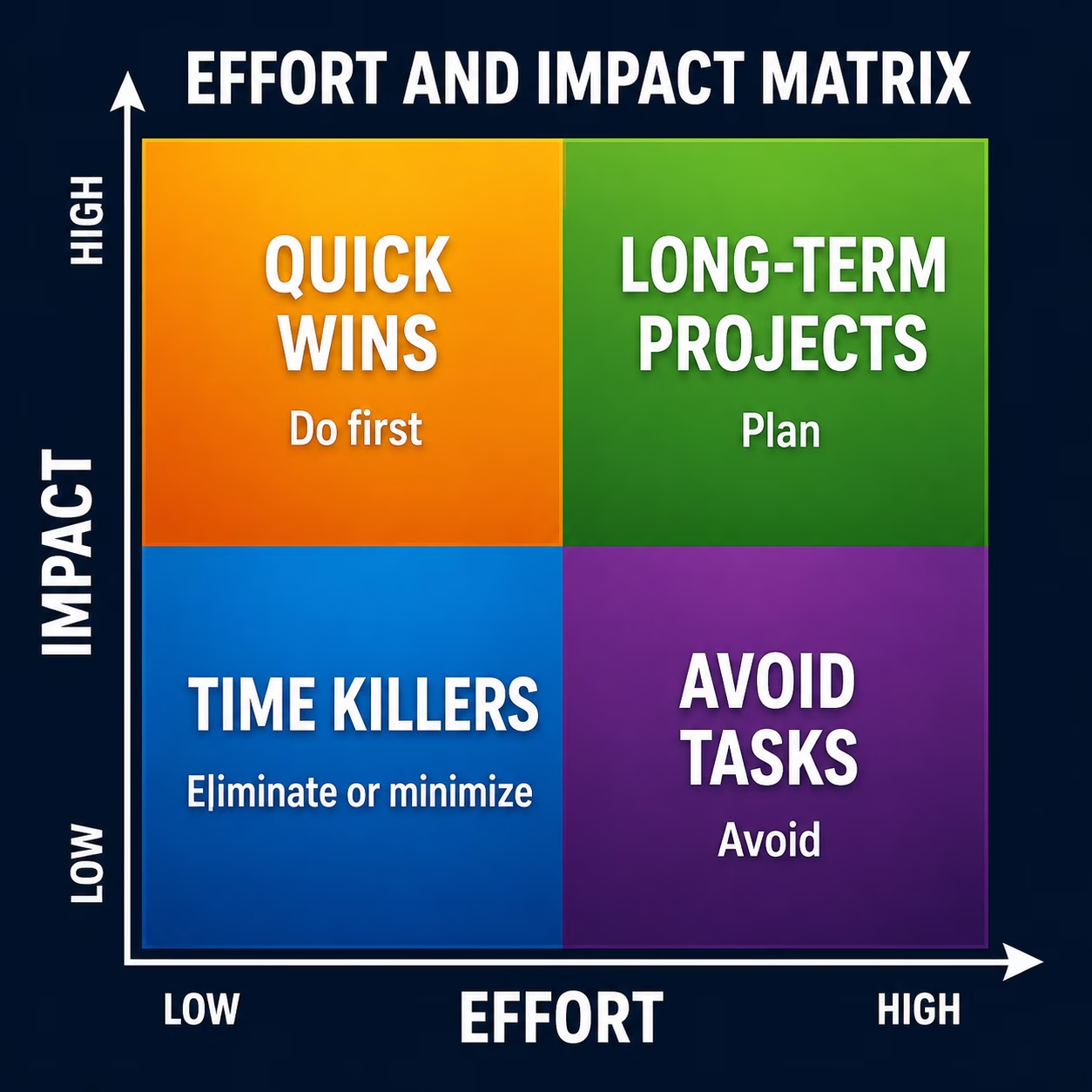
The Effort–Impact Matrix is one of the most widely used decision-making tools in management, entrepreneurship, project management, and personal development because it helps people direct their time, energy, and resources toward activities that create the greatest possible value.
This model is based on a simple but extremely important principle: not all tasks have equal value. One task may take several hours while producing only limited results, while another task may be completed in a few minutes but have a significant impact on your life, work, or project.
Success does not depend on how much effort you put in, but on how much value that effort creates.
That is why highly productive people do not ask only, "What should I do?" They also ask, "Is this task worth the time and effort I am going to invest in it?"
This matrix helps answer that question by comparing two essential factors: impact and effort. When you evaluate any task according to these two factors, decision-making becomes more objective and less dependent on emotions, habits, or daily pressures.
Evaluate effort
+
Evaluate impact
↓
Determine priority
↓
Make the right decision
The matrix is not limited to large organizations. Anyone can use it to organize their daily life, prioritize their goals, and choose which projects are worth investing in, whether they are a student, employee, business owner, or team leader.
It also helps eliminate one of the most common misconceptions: the belief that hard work alone is enough to achieve success. In reality, two people may work the same number of hours, yet one may achieve twice the results because they chose higher-impact tasks.
Impact refers to the amount of value a task creates once it is completed. The more a task helps achieve an important goal, solve a major problem, improve performance, increase income, or save time in the future, the greater its impact.
Impact is not measured by the size of the task, but by its results. A task may be very small, yet completely change the way you work, prevent major losses, or save hundreds of hours over the coming months.
Effort refers to the amount of resources required to complete a task, such as time, energy, money, skills, number of people involved, level of complexity, and potential risks.
The more resources a task requires, the higher the level of effort needed to complete it.
| Factor. | Meaning. |
|---|---|
| Impact. | The value or result produced by the task. |
| Effort. | The time, resources, and energy required to complete it. |
Because people do not always evaluate tasks rationally. They may choose the easiest task because it feels comfortable, the most urgent task because it creates pressure, or the most exciting task because it is enjoyable, even when it is not the most valuable.
This matrix forces you to look at the actual value of each task before starting it, helping you use your limited resources more intelligently.
Time, energy, and money are limited resources, so they should be invested in the activities that create the greatest value.
The goal is not to complete the largest possible number of tasks, but to choose the tasks that create the greatest impact compared with the effort required. Every decision you make about your priorities represents an investment of a resource that cannot be recovered: time.
Less effort
+
Greater impact
↓
Higher productivity
↓
Better results
After understanding the general idea behind the Effort–Impact Matrix, we will begin examining its first quadrant: Quick Wins, to understand why they are the best starting point for achieving significant results with the least amount of time and effort.
Quick Wins represent the most valuable type of task within the Effort–Impact Matrix because they produce significant results while requiring a limited amount of time, money, or energy. That is why they are the ideal starting point for anyone who wants to increase productivity or improve results quickly.
This type of task falls in the area where high impact meets low effort. In other words, you receive a significant return for a relatively small investment.
The smartest decisions are not always the most complicated ones, but the decisions that produce the greatest results with the least effort.
The importance of Quick Wins lies not only in the practical results they produce, but also in their psychological effect. They give people a sense of progress, success, and accomplishment, which increases motivation to continue working on larger tasks.
Small task
↓
Clear result
↓
Sense of accomplishment
↓
Greater motivation
↓
Additional achievements
Because people need to see tangible results in order to maintain their enthusiasm. When someone works for a long time without seeing clear progress, they may feel frustrated, doubtful, or unmotivated. Small achievements, on the other hand, provide the brain with positive signals that encourage continued effort.
That is why many organizations, leaders, and coaches use this principle when managing change. They begin by achieving quick results that build confidence before moving on to larger projects.
When a person completes a task that produces a clear result, the brain releases chemicals associated with reward, such as dopamine. This can increase motivation, improve mood, and strengthen the desire to continue working.
That is why small achievements are not merely practical results; they can also serve as psychological tools that help build positive habits and resist procrastination.
Repeated small successes are more powerful than waiting for one major achievement to happen all at once.
Despite the importance of Quick Wins, some people make the mistake of focusing on them exclusively while neglecting larger projects. Quick Wins help build momentum, but they are not enough on their own to achieve major goals.
Some tasks may also appear easy without creating any meaningful impact. That is why impact must be evaluated carefully before giving a task priority.
| A Genuine Quick Win. | An Easy but Low-Value Task. |
|---|---|
| Saves time in the future. | Does not change anything important. |
| Solves an impactful problem. | Simply creates busyness. |
| Increases efficiency. | Adds no clear value. |
| Improves results. | Creates a false sense of productivity. |
Ask yourself these questions when evaluating a task:
High impact
+
Low effort
↓
High priority
If Quick Wins produce significant results with limited effort, another type of task can create an even greater impact, but requires time, patience, and long-term planning. These are known as Major Projects, which we will explore in the next section.
Major Projects are tasks that can create the greatest possible value over the long term, but they require a significant investment of time, effort, resources, and planning. These are the projects that can transform the future of an individual, organization, or team, but they do not produce immediate results in the same way Quick Wins do.
That is why many people understand the importance of these projects but continually postpone them because they appear large, complicated, or require months, and sometimes years, before producing results.
Great achievements do not require greater strength, but greater patience and longer consistency.
This type of task falls in the area where high impact meets high effort. In other words, it requires a significant investment, but in return produces results that cannot be achieved through small tasks alone.
High effort
+
Long time
↓
High impact
↓
Long-term results
Because most major achievements in life are not accomplished in a day or a week. They require the continuous accumulation of effort, learning, development, and correction. Earning a university degree, building a company, learning a new language, or writing a book are all examples of projects that cannot be completed in a single step.
That is why successful people do not look only for quick results. They consistently invest part of their time in projects that shape their future, even when the results are far away.
The brain tends to avoid large tasks because they are not completely clear and require a long time before a reward is received. The size of a project can also make a person feel overwhelmed before even starting, leading them to continually postpone action.
This is sometimes referred to as Analysis Paralysis, where a person spends a great deal of time thinking, planning, and worrying without taking the first practical step.
Every major project begins with the smallest step.
The biggest mistake is trying to complete the entire project at once, because this often leads to exhaustion or loss of motivation. The better approach is to divide the project into measurable smaller goals and execute them gradually.
Major project
↓
Main stages
↓
Weekly tasks
↓
Daily tasks
↓
Continuous progress
| Correct Management. | Incorrect Management. |
|---|---|
| Dividing the project into stages. | Executing the project all at once. |
| Monitoring progress continuously. | Working without reviewing progress. |
| Continuing even when progress is slow. | Stopping at the first difficulty. |
| Realistic planning. | Unrealistic expectations. |
| Focusing on progress. | Focusing on perfection. |
After exploring high-impact tasks, whether they are Quick Wins or Major Projects, we will move to another type of task: Fill-ins, which require little effort but have limited impact, and how they can be managed without consuming time that could be devoted to higher-value activities.
Fill-ins are tasks that do not require much time or energy but, in return, do not have a significant impact on your goals or results. They keep daily life organized, but they do not create a major difference when compared with Major Projects or Quick Wins.
This type of task falls in the area where low impact meets low effort. Therefore, it should not be completely ignored, but it should not occupy most of your day either.
Not every task deserves to be completed first simply because it is easy.
Many people fall into the trap of these tasks because completing them gives them a feeling of productivity, while in reality they do not create meaningful progress toward their goals. This is sometimes referred to as false productivity, where a person appears busy throughout the day but does not move significantly closer to the results they want.
Easy tasks
↓
Sense of accomplishment
↓
Limited impact
↓
Slow progress
Because the brain tends to choose easy tasks that can be completed quickly. They provide an immediate sense of accomplishment without requiring deep concentration or confronting complex challenges.
The problem begins when these tasks become a way to avoid more difficult and higher-impact work. A person may spend hours organizing files while postponing the project that would provide the greatest benefit.
An easy task is not necessarily a task that deserves to be your priority.
These tasks should not disappear from your schedule because they are necessary for maintaining order. However, they should be handled intelligently so they do not consume time that should be dedicated to high-impact activities.
Instead of responding to email ten times throughout the day, set aside one period to respond to all messages. Instead of completing every small task as soon as it appears, group it with similar tasks and complete them together.
This approach helps reduce interruptions and maintain focus while working on more important tasks.
Multiple small tasks
↓
Group them
↓
Complete them at once
↓
Less time
↓
Greater focus
| Correct Management. | Incorrect Management. |
|---|---|
| Complete them after important tasks. | Start with them every morning. |
| Group them together. | Complete them as they appear. |
| Reduce the time spent on them. | Allow them to consume the entire day. |
| Delegate some of them. | Insist on doing everything yourself. |
| Automate repetitive tasks. | Repeat them manually every time. |
If Fill-ins do not require much effort, there is another type that is considered the most dangerous within the matrix because it combines high effort with low impact. These are tasks that drain time and energy without producing meaningful results, known as Thankless Tasks.
Tasks to Avoid (Thankless Tasks) represent the worst type of tasks within the Effort–Impact Matrix because they consume a significant amount of time, energy, and resources while producing limited results, or almost none at all. Therefore, continuing to perform them often leads to feelings of exhaustion and constant busyness without making real progress.
This type of task falls into the area where low impact meets high effort. In other words, you pay a high price for a very small return.
Not every difficult task is worth completing; some great efforts add no real value.
The real danger of these tasks is that they often appear important, complex, or necessary, causing a person to invest many hours in them before realizing that their final impact does not justify such a large investment.
High Effort
+
Low Impact
↓
Time Drain
↓
Limited Results
This happens for several reasons, including the desire for perfection, the fear of removing certain tasks, or the belief that greater effort necessarily means better results. Some people also continue working on an unsuccessful project simply because they have already invested a great deal of time in it. This is known in decision-making as the Sunk Cost Fallacy.
Therefore, rational thinking does not depend on how much effort was invested in the past, but on how much value continuing in the future will create.
Do not continue down the wrong path simply because you have already traveled a long distance.
The first step is to honestly ask yourself: Is this task really worth all this effort? If the answer is "no," there are four main options for dealing with it.
Eliminate
or
Simplify
or
Delegate
or
Automate
Some people believe that a difficult task is always important, but this is not true. A task may be extremely complex while adding little real value, whereas a simple task may completely transform the results of the work.
Therefore, the criterion for making a decision should be impact, not difficulty.
Great effort does not justify continuing when the return is limited.
| Task. | Appropriate Action. |
|---|---|
| Low impact, high effort. | Eliminate it if possible. |
| Cannot be eliminated. | Simplify it. |
| Someone else can perform it. | Delegate it. |
| Repetitive. | Automate it. |
After exploring the four quadrants of the matrix, we will move on to how to use it practically in daily life and how to evaluate any new task, then place it in the appropriate quadrant so that prioritization becomes faster, more accurate, and more effective.
The power of the Effort–Impact Matrix does not lie only in understanding it theoretically, but in using it consistently when making daily decisions. Every day, a person faces dozens of tasks, requests, and ideas, but time, energy, and money remain limited resources. Therefore, the best way to invest them must be chosen.
This matrix helps you pause before starting any task and evaluate it objectively instead of relying on emotions, habits, or temporary pressures.
Before starting any task, ask yourself: Is it really worth the time I am going to invest in it?
Start by recording all the tasks you need to complete, whether they are daily tasks, weekly tasks, or long-term projects. Do not try to prioritize them immediately; first, get them out of your head so that you can evaluate them calmly.
This step helps reduce mental load because the brain does not have to remember everything while thinking about priorities.
All Tasks
↓
One List
↓
Evaluation
↓
Set Priorities
After writing down the tasks, ask yourself about the real value of each task, not whether it is easy or difficult.
You can use the following questions to evaluate impact:
After determining the value of the task, evaluate the resources required to complete it.
A smart decision depends on comparing value with cost, not on looking at either one alone.
After evaluating impact and effort, it becomes easy to determine where the task belongs within the matrix.
| If the task... | Place it in... |
|---|---|
| Has high impact and low effort. | Quick Wins. |
| Has high impact and high effort. | Major Projects. |
| Has low impact and low effort. | Fill-ins. |
| Has low impact and high effort. | Tasks to Avoid. |
After classifying the tasks, do not start executing them randomly. Instead, use a clear sequence that helps achieve the best results.
Quick Wins
↓
Major Projects
↓
Fill-ins
↓
Eliminate or Delegate Low-Value Tasks
Priorities are not fixed. Working conditions may change, new opportunities may appear, or your personal goals may change. Therefore, it is better to review the matrix weekly or monthly to make sure that the tasks in it still deserve your time.
Some projects may also move from one quadrant to another over time. After simplifying or dividing them, for example, a major project may become a group of Quick Wins.
Priority management is not a decision made once; it is an ongoing process of review.
Suppose you have five tasks:
After evaluating them, the result might look like this:
| Task. | Classification. |
|---|---|
| Reply to the important email. | Quick Win. |
| Launch the website. | Major Project. |
| Organize the desktop. | Fill-in. |
| The unnecessary meeting. | Task to Avoid. |
| Learn the new skill. | Major Project. |
After learning how to apply the matrix in practice, the next section will explore the most common mistakes people make when using it and why some people fail to benefit from it despite the simplicity of its concept.
Although the Effort–Impact Matrix is one of the simplest tools for prioritization, many people do not achieve good results when using it, not because the tool is ineffective, but because of mistakes in their thinking, task evaluation, or decision-making.
Understanding these mistakes helps you use the matrix more accurately and prevents wasting time on tasks that appear important but actually add little real value.
The problem is not the amount of work, but working on the wrong things.
Some people always choose the easiest tasks because they require little effort, without asking themselves about their real value. They end the day with a long list of completed tasks but make little tangible progress toward their main goals.
Therefore, the first question should always be: What is the level of impact?, not: How easy is it?
Enthusiasm at the beginning of a project may lead a person to start immediately without defining the stages, resources, or time required. After a short period, they may feel exhausted, lost, or unmotivated and stop before achieving any meaningful result.
The solution is to divide the project into small steps and define measurable milestones.
A major project becomes manageable when it is transformed into a series of smaller tasks.
Many people believe that a busy day is a productive day, but the truth is that constant activity does not necessarily mean meaningful results. A person may work for ten hours while someone else achieves greater results in three hours because they focused on higher-impact tasks.
Therefore, the goal is not to fill your time, but to create the greatest possible value during that time.
Busyness
≠
Productivity
A task may be highly valuable today but become less important after a week or a month. New opportunities may also emerge that deserve priority. Therefore, prioritization requires continuous review rather than a fixed decision.
It is preferable to review the matrix weekly, especially when managing multiple projects.
Some people refuse to delegate because they believe they are the only ones capable of doing the work correctly. However, this mindset often leads to accumulating tasks, exhaustion, and declining performance quality.
If a task has low impact and someone else can perform it at an acceptable level of quality, delegation is often the better decision.
Do not do yourself what someone else can accomplish while you focus on what only you can do.
A person may spend hours improving small details that do not affect the final outcome, while that time could be invested in work that creates greater impact.
The pursuit of perfection can sometimes delay completion or prevent a project from being completed at all.
When you choose to perform one task, you are simultaneously giving up the opportunity to perform another. Therefore, the right question is not only: "Is this task good?" but also: "Is there a better task I could do instead?"
Every Choice
↓
Means
Giving Up Another Option
| Mistake. | Solution. |
|---|---|
| Focusing only on effort. | Evaluate impact first. |
| Starting without a plan. | Divide the project into stages. |
| Constant busyness. | Focus on results. |
| Failing to review priorities. | Review them weekly. |
| Refusing to delegate. | Delegate low-value work. |
| Pursuing perfection. | Focus on completion first. |
| Ignoring opportunity cost. | Compare all available options. |
In a world filled with tasks, responsibilities, and opportunities, the real problem is not a lack of time, but how it is invested. Every person has twenty-four hours a day, but the difference between more successful and less successful people often does not come from the number of hours, but from the quality of the decisions they make about how to use those hours.
This is where the importance of the Effort–Impact Matrix comes in. It does not merely help you organize your task list; it teaches you a new way of thinking based on directing limited resources toward the activities that create the greatest possible value.
Success does not depend on doing more tasks, but on doing the tasks that have the greatest impact.
In this article, we explored the basic concept of the matrix and the difference between effort and impact, then examined its four quadrants in detail:
Execute
↓
Plan
↓
Simplify
↓
Eliminate
We also learned that evaluating any task should come before executing it, and that the two fundamental questions are:
Answering these two questions honestly prevents much of the waste of time, energy, and money because it helps you make more conscious and rational decisions.
One of the biggest mistakes many people make is using the matrix once and then returning to their old way of working. Its true value emerges when it becomes a mental habit that accompanies you before starting any project, accepting any task, or making any decision.
Over time, you will become better at distinguishing what deserves investment from what should be ignored, and prioritization will naturally become faster and more accurate.
Correct thinking about priorities is a habit, not a skill you use only when needed.
| Principle. | Core Idea. |
|---|---|
| Focus on value. | Start with the highest-impact work. |
| Invest your time. | Do not consume it on low-value activities. |
| Plan major projects. | Break them into manageable stages. |
| Leverage Quick Wins. | To increase motivation and achieve rapid results. |
| Review your priorities continuously. | Because circumstances and goals change over time. |
Productivity is not measured by the number of hours you work or the number of tasks you complete, but by the amount of impact those tasks create in your life, your goals, and your future. Therefore, a productive person is not the one who is the busiest, but the one who is most capable of choosing what is worth working on.
Every minute you invest in a high-impact task is an investment in your future, and every minute you waste on a low-value task is a missed opportunity that cannot be recovered.
True development begins when you stop adapting to other people's expectations and start setting your own rules. Through our training packages, we focus on liberating you from limiting patterns, boosting confidence in your decisions, and building a confident personal presence that positively impacts all areas of your life. Invest in your awareness, and turn your potential into tangible results.
Start Your Journey of Change Now© 2022 Copyright All rights reserved. Designed by Tarik Elouahbi.