
Exploring the Triune Brain: How Instinct, Emotion, and Logic Shape Your Self, Behavior,
Decisions, Relationships, and Personal Growth?

For simplicity, we will use the Triune Brain Model as a conceptual framework to help us understand different behavioral patterns. However, modern neuroscience research indicates that the brain is much more integrated and complex than this model suggests, and its functions arise from the interaction of multiple brain networks rather than separate parts working independently.
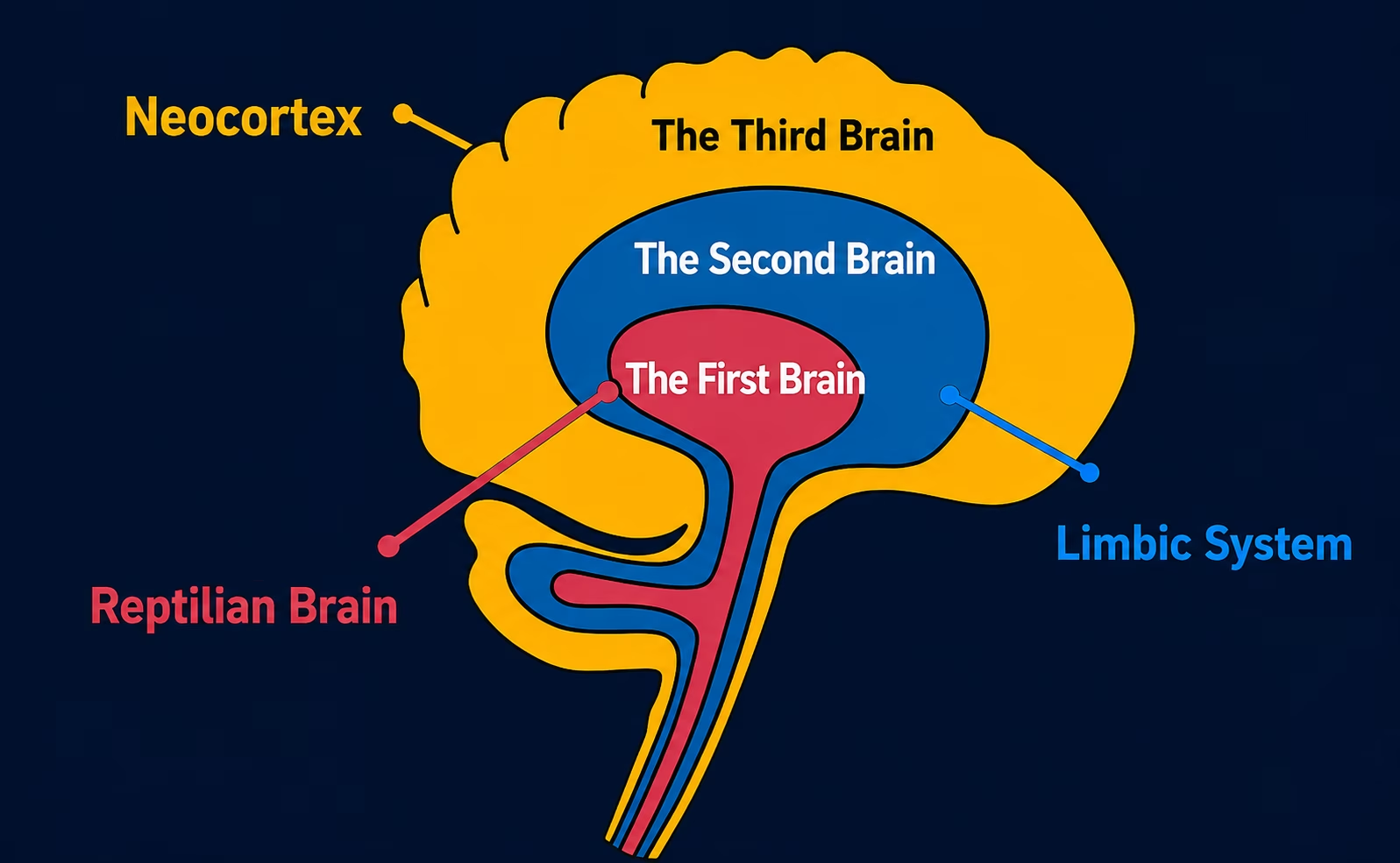
Understanding the human mind
Component / Model Primary Functional Role Associated Functions & Processes
Reptilian Brain


Concept within the Triune Brain Model
Basic life regulation
and rapid, automatic responses
  • Regulation of breathing and basic vital rhythms
  • Regulation of heart rate and blood pressure
  • Regulation of certain autonomic nervous system functions
  • Regulation of sleep, wakefulness, and circadian rhythms
  • Regulation of certain reflexes and automatic movements
  • Coordination of movement, balance, and muscle tone
  • Contribution to rapid responses to stimuli
  • Maintaining the body's internal balance (Homeostasis)
  • Contributing to the regulation of certain basic drives via other brain networks
Limbic System


A group of interconnected structures and networks
Processing emotions
drives, memory, and learning
  • Processing fear and threat
  • Contributing to the processing of anger and emotional responses
  • Reward, motivation, and goal-directed behavior
  • Processing certain aspects of pleasure and desire
  • Formation of new memories and retrieval
  • Connecting experiences with emotions
  • Learning from outcomes, rewards, and punishments
  • Contribution to social behavior and attachment
  • Contribution to the regulation of certain drives related to food and sex
  • Interaction with the autonomic nervous system and physical responses to emotion
  • Contribution to evaluating the significance of stimuli for the individual
Neocortex
Complex cognition
thinking, planning, and executive control
  • Sensory perception and information processing
  • Attention and directing mental resources
  • Thinking, analysis, and reasoning
  • Planning and strategy formulation
  • Problem solving and decision making
  • Working memory and temporary information processing
  • Cognitive flexibility and strategy shifting
  • Inhibition of certain inappropriate responses
  • Regulation of goal-directed behavior
  • Understanding and producing language in collaboration with specialized brain networks
  • Abstract thinking and symbolic thinking
  • Evaluation and comparison between alternatives
  • Predicting potential outcomes and planning for the future
  • Self-monitoring and awareness of certain mental processes
  • Contribution to the cognitive regulation of emotions

- The Triune Brain: How Do You Make Decisions Between Emotion, Instinct, and Logic?

The following table illustrates the fundamental differences in the mechanisms of action of brain regions, and how each part translates information based on its specific function.
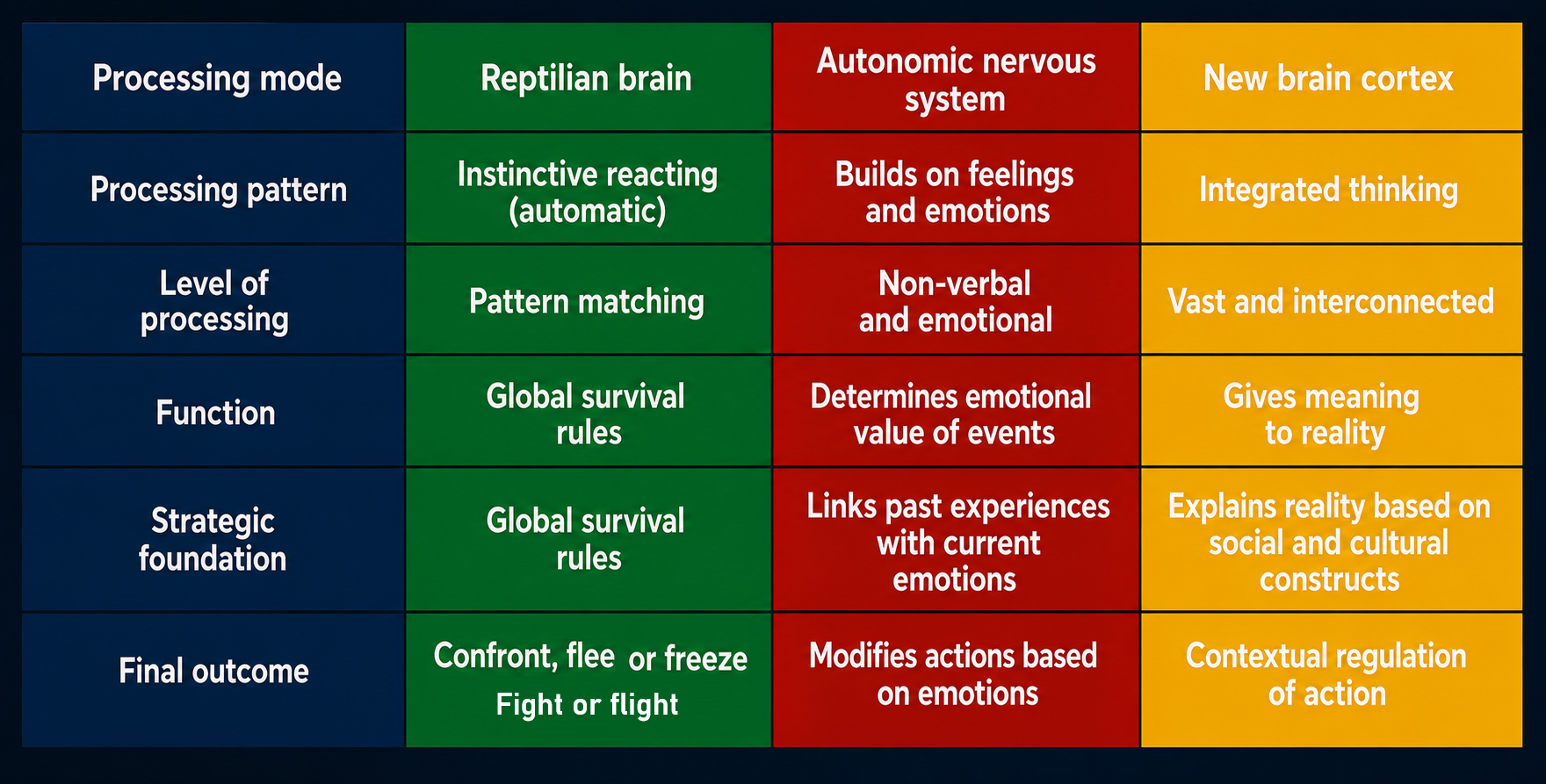
Understanding the human mind

- Real-Life Example: "Survival in a Jungle."

Imagine you are walking in a jungle and suddenly hear a sound behind the bushes:

  • Reptilian Brain: Will react instantly by increasing your heart rate and preparing your muscles to run (instinctive survival response).
  • Limbic System: You will feel a wave of fear and anxiety based on your past memories of dangers.
  • Neocortex: After a few seconds, you will begin to analyze the situation: "Is this just a pet or a real danger?" to decide whether to keep walking or move away cautiously.

- Conclusion:

  • Reptilian Brain (Brainstem/Instinctive Brain): Is the primary driver of survival instinct, automatic functions like breathing, and fight-or-flight responses in moments of danger.
  • Limbic System (Emotional Brain): Represents the center of feelings, memory, and motivation, and is responsible for shaping your daily responses and guiding your emotional behavior.
  • Neocortex (Thinking Brain): Is the highest part of the brain, responsible for logical thinking, learning, complex decision-making, and advanced analytical capabilities.

Upcoming articles will discuss each of these parts in detail.

Are you ready to reclaim your personal sovereignty?

True development begins when you stop adapting to other people's expectations and start setting your own rules. Through our training packages, we focus on liberating you from limiting patterns, boosting confidence in your decisions, and building a confident personal presence that positively impacts all areas of your life. Invest in your awareness, and turn your potential into tangible results.

Start Your Journey of Change Now
you need help?